
Waking up in this life is the most difficult and most consequential thing we could possibly imagine. Why would we think that we could do it ourselves? Why would we not want to take advantage of others who have been there? … Lineage offers a sort of context for the journey. It offers a vision of what is possible … [and] gives a sense of affiliation with those great men and women who have gone before … [Yet] at the same time that we draw from and depend on a lineage, it is also completely up to us.”
Continue readingOPL5: Chapter 2: The support: a precious human existence
So now we have a compelling reason to want to wake up, AND our first prerequisite is checked off! The first prerequisite, buddha nature, is pretty much all good news: this simple and powerful potential to purify all our obscurations and to fully develop wisdom and compassion is naturally possessed by all beings without exception. If there’s any bad news, it’s temporary and doesn’t apply to everyone: it’s that some beings are much closer to realizing buddha nature than others, per the five degrees or stages described by Gampopa — but if you’re reading this, there’s no bad news for you. You’re almost certainly in the mahayana stage, the best jumping off point for the path.
Next among Gampopa’s six topics on the path: we need a framework or support for realizing our full potential, and this time there’s definitely good news and bad news.
Continue readingOPL4: Chapter 1: The cause: buddha nature
In truth, anyone who practices with great effort cannot fail to reach enlightenment. Why? Because all forms of conscious life, including ourselves, possess its prime cause. Within us is buddha nature.” ~ Gampopa OPL, translated by Ken Holmes.
We got the bad news right off the bat in Gampopa’s introduction to OPL: the confusion and suffering of samsara will never clear up without hard work on our part. Fortunately, he leads off the first chapter with the good news: if we do that work, the result is guaranteed. In this chapter, “we” includes not only present students of the dharma, but all humans whatever their material situation or belief system; and not only humans, but all beings, from the highest gods to our cherished pets to the earthworms in our garden to the most miserable denizens of literal or psychological hell. We all meet the first and most important of the three prerequisites for buddhahood. We all have the potential to wake up.
Why should we believe this? Gampopa backs up his guarantee with three categories of evidence:
Continue readingOPL3: The case for awakening
Gampopa Sonam Rinchen, the 12th-century physician from Dakpo who entered monastic life after his wife and two children died in an epidemic, and who went on to “unite the two streams” of practice and establish the Kagyu Lineage that continues to flourish today, began his A-Z guide to the path of awakening with a concise introduction that makes a compelling case for why we should go to all this trouble in the first place. But what, exactly, is wrong with life as we know it?
Continue readingOPL2: A note on translations and titles
The very first English translation of Gampopa’s 12th-century guidebook to awakening, by the German scholar Herbert Guenther, was published in 1959, and reissued in 1971 with a cover design and foreword by Chogyam Trungpa Rinpoche. It thus has excellent credentials and blessings, and it made available to the West for the first time the systematized Kagyu path to awakening from A to Z.
I still find Guenther’s translation occasionally the most spot-on (in my opinion), but it was a pioneering effort, and he translated the title as The Jewel Ornament of Liberation. This title has stuck for 60 years, even though we now know it to be slightly incorrect.
Continue readingOPL1: Who was Gampopa?
Here begins our next class, on the essential comprehensive Kagyu guide to the path of awakening, Gampopa’s Ornament of Precious Liberation, aka, Jewel Ornament of Liberation. Class info is above, in “About the Gampopa OPL study guide.”
When Guru Vajradhara Chamgon Kenting Tai Situpa (Situ Rinpoche) began broadcasting an intensive course on Ornament of Precious Liberation some years ago from his home seat of Sherabling in India to his worldwide network of Palpung monasteries and centers, including PTC, he spent the first six sessions on Gampopa’s life. He explained that if we didn’t understand what an extraordinary being Gampopa was, we would not appreciate how extraordinary his teachings were.
Continue readingKyabje Kalu Rinpoche’s visit to PTC Monastery October 2018
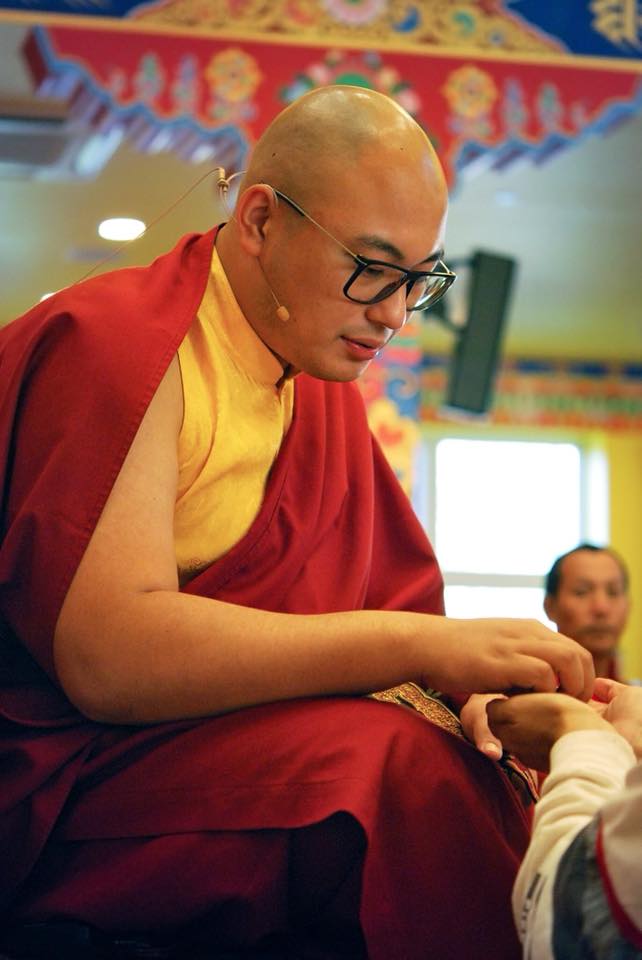
PTC had a wonderful visit from Kyabje Kalu Rinpoche October 20-22, 2018. Videos of his teachings are available at this link Note: this link may no longer be active.). There is a fee for most of them to help support visiting teachers and livestreaming of teachings. However, the public talk with Q and A (Note: this video may no longer be available.) on October 22 at 7:30pm (the final video) is free of charge. (If a password is requested, type in FREE. Note: On the free video, there is no audio until Kalu Rinpoche’s arrival at about 19 minutes.)

Meanwhile, for a brief summary of the main points of Kalu Rinpoche’s teachings at PTC, click “continue reading”:
And let it begin with me
Before I get started on the Gampopa Ornament of Precious Liberation class notes, here’s a short presentation I gave a couple of weeks ago at an interfaith prayer service in Richmond, Virginia. Organized by Chaplain David Curtis at Westminster Canterbury Retirement Community, the service’s theme was how peace can be lived in different areas of life: self, home, community, and the world. While Buddhism would have been a natural fit for peace within self, I addressed how it views the possibility of peace in the world.
37 practices: full translation, audio, and meditations
Links to the complete translation and full audio of the 37 practices may be found on the 37 practices translation page.
I’ve also added a page for audio of guided meditations we’re doing this month as part of our abbreviated “37 practices summer camp” program, meeting Thursdays from 1:00-1:45 pm via Zoom until we begin our next class, Gampopa’s Ornament of Precious Liberation, in the fall. More info on this in the 37 practices wrap-up post. We hope to see you there.
The guided meditations can also be accessed via the same link as audio and video of the 37 practices classes, which can also be found under the “Links” heading on the right hand side of the screen.
37 practices: mindfulness, vigilance and integrity (35 and 36, part 2)
Mindfulness, vigilance and … a loophole! Each and every verse resonates with me, but I feel that in particular verses 35 and 36 are the heart of the 37 practices. As I said in the post on these verses, linked above, each of the preceding practices in fact depends on mindfulness and vigilance. To review: mindfulness knows what will help us awaken and what will dig us deeper into samsara; and vigilance knows which one we are doing.
We’ll get to the loophole in a bit.